
The system isn’t working properly
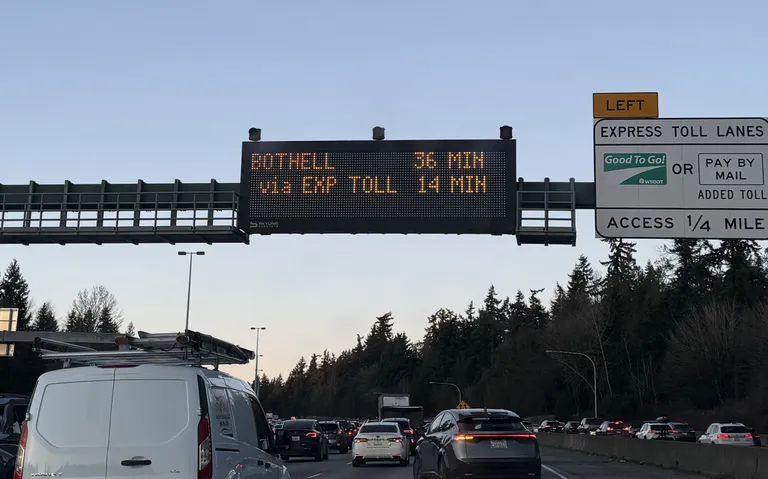
Every weekday, I drive southbound on Interstate 405 and watch the same pattern play out. Traffic slows to a crawl, and the toll-lane sign ahead jumps to $10, $12, sometimes $15. Most drivers hesitate and stay where they are. At the same time, the express lanes are moving. They are not empty, but clearly not full, either. Often there are two express lanes, both flowing, with enough space to make me wonder why more of the drivers are not using them.
As someone trained in operations research and industrial engineering, I tend to look at this less as a frustration and more as a system trying to do its job. From that perspective, the issue is not pricing itself. It is what the pricing is trying to optimize.
The express lanes are designed to stay reliable. Prices rise as congestion builds so that traffic in those lanes keeps moving. That part works as designed. But during the evening commute, when the entire corridor is under pressure, higher toll prices also discourage drivers from shifting into lanes that still have room. The result is a split system where the express lanes keep moving fast while the general lanes absorb more cars than they can handle.
Traffic behaves in a predictable way under these conditions. We can think of the highway as a set of lines feeding into parallel checkout counters. If one or two counters are kept partially open while the others are overwhelmed, the total wait time goes up for everyone. The system is simply not using all of its available capacity when it matters most.
That is what it feels like on I-405 in the evening. The general lanes are operating past their limit, which is why traffic can quickly shift from slow to stop-and-go. Once that happens, it takes a long time to recover. Meanwhile, the express lanes continue to move steadily, but without carrying as many vehicles as they could. The result is more total delay, even though part of the system appears to be working well.
This is not about whether tolling is good or bad. It is about what the pricing is trying to achieve. In more technical terms, it is about the objective function the system is optimizing. Right now, the system is set up to protect speed in the express lanes, almost at any cost. That is a valid goal, but it is not the only one that matters.
If the objective is instead to move as many people as possible through a constrained corridor, especially during the busiest part of the day, then pricing should help balance traffic across lanes. It should make use of all available capacity. Right now, it often does the opposite by keeping the faster lanes from filling up just when the rest of the highway needs relief.
There are straightforward ways to improve this. Prices could be adjusted to keep the express lanes busy but still moving, instead of letting them remain partially utilized during peak demand. Another option would be to watch the time difference between lanes. If the express lanes become significantly faster than the general lanes, the price could ease down to encourage more drivers to use that space. The lanes would remain faster, but unused capacity would no longer coexist with growing queues.
We are not likely to add new lanes to I-405 any time soon, which makes it even more important to use the lanes we already have as effectively as possible. This is not a political argument. It is a practical one. When part of a system is underutilized while another part is overloaded, the system can be tuned to perform better.
Most evenings, the answer is right there on the road. We are leaving capacity unused at the exact moment we need it most.